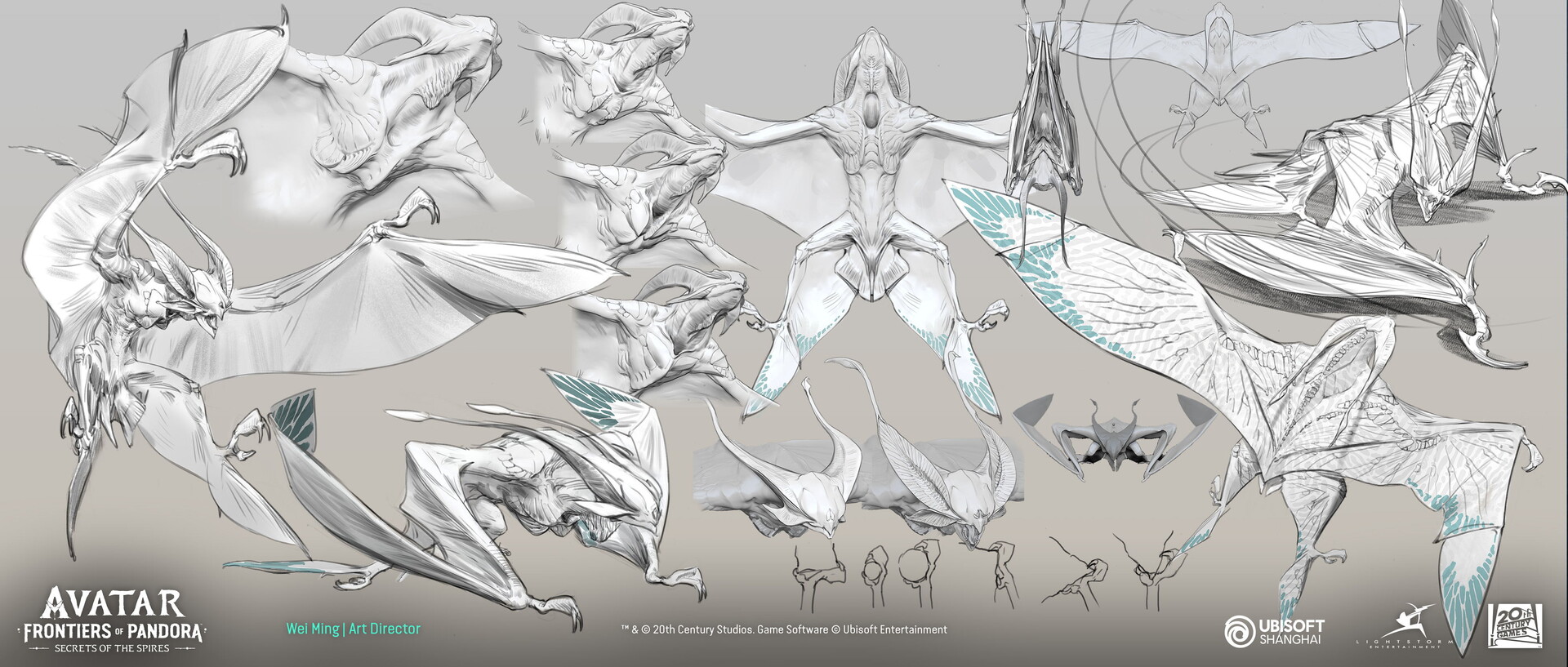
Avatar Chiroptera A
The chiroptera is an entirely blind, cave-dwelling aerial predator that relies on acute hearing and echolocation to navigate and hunt its primarily airborne prey. Its physical adaptations include:
Anatomy:
A smooth, eyeless head with a powerful, beak-like jaw.
Long, supple parietal ears (with additional lateral ears) and short, feathery antennae at the front.
A muscular torso with four slender limbs featuring webbed, leathery membranes that support a large wingspan—up to ten meters.
Each wing ends in sharply hooked digits, and one digit is specialized for clinging to surfaces and hunting.
Behavior:
Uses multi-frequency barks from its larynx combined with complex cochlear-like chambers for precise echolocation.
Its subsonic barks can stun and disorient prey.
Roosts in deep, sunless cave systems, hanging from ceilings during daylight and laying eggs in protective ootheca that house hundreds of embryos.
Social Structure and Defense:
Hatchlings are highly active but vulnerable, staying within the cave nest and emitting alarm shrieks when threatened.
Only a few hatchlings survive to adulthood, eventually forming small, social colonies often sharing caves with other predator packs for mutual defense.
Colonies are organized into three groups: mature breeding males and elder females (matriarchs), subadult nonbreeding males, and the more timid hatchlings.
In defense, hatchlings alert the colony, medium-sized males form a protective swarm around the matriarch, and the largest males engage the aerial threat directly.
This multi-layered system of specialized anatomy, precise echolocation, and coordinated social defense enables the chiroptera to thrive in its challenging, lightless cave habitats.